Verifying My Blog on Ping.sg

1 AMED Tourism and Vacations in Bali

Amed attractions has a beautiful coast with sunrise, underwater life also offers a great place to practice diving or diving. There is a Lake on the edge of a flat beach is good for exercise, as well as the rock which can be reached by swimming for 5 minutes. Here is great for snorkeling and diving, this area is also growing because of its beauty. Access to the site from the airport approximately 2.5 hours away by car.

Amed beach is located at the eastern end of the island of Bali, in the village of Amed, Abang, Karangasem Regency, Bali. A lot of important tourism facilities such as restaurant, hotel and bungalows here. Public life here in general are fishermen. The rural atmosphere is thick, pristine traditions have not affected the foreign culture, hospitality is still thick, beautiful Sunrise/sunrise in the morning, while enjoying breakfast, will add to the exotic atmosphere during the holidays/tours in Bali.

English: Amed Beach:: English version
Brine Rice Terrace View: journey to Amed

With a black sandy beach, crystal clear water conditions, diverse marine life, coral reefs, water preserved maintained constant warmth is not changeable, so the snorkeling and diving here is very sought after by tourists domestic and foreign tourists. If you continue walking down the sights of the coast of Amed you will meet with the village of Jemeluk and found small pieces and the most beautiful coral garden you'll ever see. 

Understand

Amed refers to a long stretch of coast running from the village of Cucik about 14 km eastwards incorporating the seven villages of Amed, Jemeluk, Bunutan, Lipah, Selang, Banyuning and Aas. The pace of life here is slow and the coastal scenery quite stunning making Amed the perfect place for a relaxed holiday in Bali.
Amed is the most recent tourist development area in Bali. It was only in 2000 that tarmac was laid on the roads. Telephone lines were installed in 2003 and it took until 2007 for a bridge to be built over a section of the main road that regularly washed away during the rainy season.
This is the most commonly used base for visitors wishing to dive the USS Liberty wreck at Tulamben and that area is also covered by this article. There are other good dive sites close at hand and a thriving dive industry has developed all the way along the coast here.
Amed's inhabitants live from fishing, salt-making and tourism. The lack of tourism-based revenue, its remote nature and the generally harsh environment for farming, meant that this area was very much one of the poorer areas in Bali. Amongst others, the East Bali Poverty Project [1] drew attention to the plight of the local villagers in this area and that, together with recent tourist development, has gone a long way to improving general standards of living, health and education.


Map of the Amed Area
Amed lies on the north-eastern tip of Bali, a little more than a two hours drive from the Ngurah Rai International Airport. A taxi service to Amed is available at the airport for about Rp 400,000.
Amed is accessed by turning east at the village of Culik which lies on the main east coast road from Karangasem to Singaraja.
Shuttle buses regularly serve the destination from Candidasa and Lovina and now that the road has been greatly improved, they take you all the way into Amed (previously all buses stopped at Culik and motorbikes ferried visitors into Amed). Perama [2] operates optional shuttle buses from Padang Bai or Candidasa to Tirtagangga, Amed and Tulamben (Rp 125,000, min. 2 people). Depart : 9.30AM & 2PM - Return : 11AM. There is no Perama office in Amed.
The easiest way into Amed though is to hire your own transport with a driver. Be aware that the Amed district is stretched out over more than 10 km. Transport by local drivers is widely available in Amed. Transport to Padang Bai should not cost more than Rp 150,000.
If you are coming from the islands to the east, Amed Sea Express [3] offers pick-up in Lombok, Gili Trawangan, Gili Meno and Gili Air with twice daily service to Amed arriving at 9:15AM & 1:15PM.

Get around

Public transport in Amed is rare. There are bemos (mini buses) from Culik as far as Aas (that pass through Amed) but mainly in the morning. Later in the day it is almost impossible to find public transport. The easiest way to get around is to hire a car and driver. Motorcycles are widely available for rent and you should expect to pay Rp 50,000-80,000/day.

See


The black sand and fishing boats of Amed
Amed is famous for its beaches, lined with traditional outrigger fishing boats. There is quite coarse black volcanic sand at Amed village beach. As you move further east (and away from Mount Agung), the beaches have softer sand and become more of a mid grey-brown in colour. The prettiest bays are probably those at Jemeluk and Lipah but the whole stretch of coastline is very attractive.
Salt production is a declining but still important industry in this area. As you drive along the main coast road through the villages you will see large open drying pans crusted with salt crystals. Those little boxes of gourmet Bali salt crystals you see in delicatessens and speciality food stores all over the world may have started their long journey from these very pans.
There is vibrant marine life close offshore in clear seas.
  • Mini Zoo, Selang (at the Selang Resort), +62 85 237506739 (), [4]. 7AM-9PM. Many kinds of birds (cockatoo, lory, hornbill), reptiles (python, tortoise, skink) and mammals (slow lori, palm civet, porcupine). Rp 20,000
  • Shell Museum, Bunutan (at the Aiona Garden of Health). An odd little place and a very charming one to boot. Exactly as it says, shells. Rp 20,000.  

Do


Jemeluk Bay with Mount Agung in the distance
Most people come to Amed as a getaway, including expats from other parts of the island. It is a favourite honeymoon destination for tourists and is very popular with divers and snorkelers. Day trips to local places of interest such as the water palace at Tirta Gangga and Bali's most sacred temple, Besakih, can easily be arranged. Mount Agung with lots of trekking options just 30-40 minutes from Amed.
Traditional outrigger boats are available for fishing charters from the main beaches in the Amed area. This normally involves early morning trolling for mackeral.
Have a traditional massage on the beach. Women from the local villages are always on hand for an invigorating massage, speciality so at Lipah Beach.
Enjoy nature and go with the wind on a traditional sailing boat for diving, fishing, exploration, dolphin watching, snorkelling or just swimming and relaxing.
You can get your visa extended here for Rp 500,000, which takes a week. That's generally cheaper than doing so in south Bali. Dive Concepts can tell you where to go for that and probably other dive centres too.

Freediving

Amed and Tulamben are fast becoming recognised as the best place in Bali to learn freediving (apnea or breath-hold diving). 2 Freediving schools are located in Amed (Apneaista) and Tulamben (Apnea Bali) plus several other instructors use those locations for providing courses.
Jemeluk bay in Amed is most favoured, due to it's deep coral walls and lack of strong currents. Based there is the Apneista Freediving training and Yoga space. It is Bali's first freediving school and they have a beautiful training space and Yoga sala right on Jemeluk beach. The training is open to all and ranges from complete beginners, the basic level freediver to more advanced coaching for those who have received freediving training elsewhere. The training is influenced and supplemented with various aspects of Yoga education. For more see Apneista freedive training and yoga education
In Tulamben, in the close vicinity of Liberty wreck, Apnea Bali Freediving Education is located. Courses for all levels are provided in Apnea Total and SSI systems. Training and coaching sessions are also provided for advanced freedivers. Those who can afford to stay a little bit longer special Master program has been developed. In 4-5 weeks intensive intern-ship-like training people are reaching apex of their freediving capabilities. Those who are in area for short time can try freediving in "Dicover Freediving" 1-day course. Guys from Apnea Bali made the wreck their kingdom and there is a big chance that everyday you will find them freediving there. For more see Apnea Bali Freediving Education

Yoga

Viktoria, [5] offers yoga lessons in Amed. She studied and started to practise in Nashik, India and has been teaching classic Hatha Yoga since 2006. Each lesson is 90 min.
Apneista Freediving and Yoga school has recently opened a beachside yoga sala and training space in Jemaluk bay, most days there is a 90 minutes Asana class in the evenings and often in the mornings. They also offer workshops in other aspects of Yoga such as Pranayama and Meditation. See [6] for more details.

Snorkelling

Amed has some good snorkelling within metres of the shore. A reef follows the majority of the coastline and is quite close in. Due to the limited number of visitors to the area and a growing conservation awareness among the locals, the sea life is healthy and abundant. There is a small wooden wreck in only 1.5 m of water off Lipah Beach, however this is not the World War II "Japanese Wreck". David Pickels' book on diving in Bali described this dive site for the first time back in 1999 as the Lipah Bay Wreck, and he admitted his mistake in the meantime. Matter of fact is that the real Japanese shipwreck is not located in Lipah Bay at all, but just a few kilometres further east along the coast, in the village of Banyuning and is great for diving & snorkelling with abundant coral & fish life - this dive site is locally known among the dive operators as the "Japanese Wreck" and is clearly signposted with ample car parking and snorkel equipment rental on location.
Best places for snorkelling are:


  • Japanese Shipwreck in Banyuning, small ship at 20m from the beach, awesome corals with tons of fish
  • Jemeluk, an absolute highlight with beautiful coral formations and loads of fish.
  • in front of Pondok Vienna Beach in Lipah. Waters can be very rough here.
  • small wooden shipwreck at Lipah beach
  • Bunutan beach, very good stretch between Bedulu Resort and Hotel Santai (eel garden, beautiful coral, not so many fish)
  • Selang beach, in front of Good Karma Bungalows (visibility isn't always good because of strong currents)
  • in front of Amed Cafe
  • Liberty shipwreck at Tulamben, some of which is in water shallow enough to allow snorkelling.

Diving

There is some fine diving in Jemeluk Bay both from the beach and from boats in deeper water. After a gentle slope out from shore, the wall here drops off dramatically to depths of 40 m plus. The coral is healthy and fish life abundant. There are some good drift dives further east at Selang and Bunutan but these are generally only suited to more experienced divers.
Beware of diving after a heavy rain, the water from the run-off can greatly reduce visibility in the water.

0 Gitgit Waterfall is The Beautiful Waterfall in Bali

Gitgit Waterfall is a beautiful tourist destination in north part of Bali. It is located on the north of the Southeast Asian island, not too far from Lovina and the old island capital Singaraja. Gitgit waterfall is located in the plateau area with the height about 35 meters and it is surrounded by tropical tree and emits the constantly natural water debit during the year. Waterfall voice around the charming nature was amazing and it was the separate attraction which can be enjoyed by each visitor who comes to visit. There are some plantations protecting the rain forest around the waterfall and in this place we often met the wild monkey to get the water from this waterfall.

Tourist Destination in North Part of Bali

 
Gitgit Waterfall is one of the famous tourist destinations in Bali which is located in Gitgit countryside, Sukasada sub district and about 10 Km from Singaraja Town or about 70 Km from Denpasar. It is set at height land about 300 meters above sea level. Beside of Gitgit, there is another important spot point like the monument for hero struggle of Singaraja resident who dead on the battle against the Dutch colonialist. This monument is called Bhuwana Pangkung Bangka. This Monument is extant monument and idol of people struggle action against the Dutch colonization. This monument is located in Gitgit countryside and Sukasada sub district and about 17 Km from Singaraja Town . It is situated on the hill bank. The facilities are available at Gitgit Waterfall is consisted of the parking area, restaurant and art shop. It is not far from the waterfall 
place, there is a place for taking a rest while enjoy the beauty panorama of rice terrace and Buleleng Beach
 
In order to visit the Gitgit waterfall, all visitors will follow the walkway down until the spot point. This road is one of the omissions in Dutch era where the local resident uses it to access other regions. On 1975, this waterfall is opened as tourist destinations in north part of Bali . Since it is appointed as a tourist destination in Bali, many tourists from domestic and foreign countries visits this waterfall.

0 Lovina Beach in Bali

 
Lovina Beach (or often simply Lovina) is a coastal area on the northwestern side of the island of Bali, Indonesia. The coastal strip stretches from 5 km west of the city of Singaraja to 15 km west. Singaraja is the seat of Buleleng Regency. The Lovina area contains the small villages (from east to west) of Pemaron, Tukad Mungga, Anturan, Banyualit, Kalibukbuk, Kaliasem and Temukus. It is becoming more popular with tourists but remains far quieter than the tourist hotspots of the island's south side.
The area takes its name from a home owned by Pandji Tisna, a Regent of Buleleng and pioneer of tourism to Bali in the early 1950s.
Popular activities for visitors include early-morning boat trips off the coast to see dolphins.

History
Around the 1950s, Anak Agung Panji Tisna, had traveled to several countries in Europe and Asia. He stayed several weeks in Bombay (now Mumbai). What attracts him most was the life of the people in India. By observing the people way of life in the area, then he got the thought and the outlook for Bali, especially the development of social welfare, especially in the Buleleng region. While he was in Bombay, Panji Tisna saw a place that beautifully laid out as a spot for leisure on the beach. The land has much similarity with which he owned on Kampung Baru Beach – Buleleng – North Bali, that also lies between two rivers. Panji Tina’s inspiration arises to create a resort like that. The land already in hand.
Returning from abroad in 1953, Anak Agung Panji Tisna immediately declared his muse and began to build on his land, a cottage called Guesthouse "LOVINA". The place was designed for the "travelers" or tourists for a vacation. The guesthouse was furnished with 3 bedrooms and a small restaurant near the sea. Some business observers claim cynically, that the plan of Panji Tisna will not work as expected. The time was too early to make business of such a kind, on a secluded beach such as the beach of Tukad Cebol. Local cultural observer states, "Lovina" was a foreign word, not Balinese. Furthermore, there is no letter "v" in Balinese alphabet. Another comment say, do not use the word "Lovina". “Lovina” must be deleted. Anak Agung Panji Tisna, in 1959, sold the Lovina Guesthouse to his kin, Anak Agung Ngurah Sentanu, 22 years, as the owner and manager of Lovina. Business is going pretty well. However, there are no travelers or tourists. Only a few of Panji Tisna’s friends came from America and Europe, as well as the regional government officials and businessmen from Singaraja for a vacation. Feel lucky too, because on special days such as Sundays and holidays, also on holidays such as Galungan and Kuningan, many people including students came to enjoy the natural atmosphere on the beach of Tukad Cebol.
"Karma" in the life of Lovina.
Singaraja was the capital city for Bali - Lombok, and Nusa Kecil, maintaining a steady state as a center of government and commerce activities for so long. However, such conditions suddenly change. In early 1960, the capital moved to Denpasar. Singaraja was left as a deserted city. Construction activities, and trade plummeted in Singaraja. It needs years to get back to the normal conditions in North Bali. The young manager, Ngurah Sentanu had the worst experience in running the "Lovina Guesthouse". But he accepted the task and mandate from Panji Tisna. What the business analysts had foreseen is correct. However, is there really something wrong with Lovina?

The beginning of tourism in Bali.
Bali Beach Hotel built in 1963, since then tourism became popular in Bali. Construction of tourism facilities such as hotels and restaurants began to spread throughout Bali. Tourists flock to Bali after the Ngurah Rai International Airport opened in 1970. Buleleng programmed so that the government encouraged the tourism sector as one of the mainstay for economic progress and social welfare. In the meantime, the spotlight focused on the role of Lovina in the field of tourism, emerging pros and cons.
North Bali starts to squirm.
In the Eastern part of Buleleng regency, the natural fresh water pool of Yeh Sanih, in the village of Bukti being extensively renovated, rose as a rival to Lovina. The development of Yeh Sanih got more support than Lovina, both by the government officials and the tourism observer. That is because Yeh Sanih is indigenous. Meanwhile, the travel agents choose Lovina, as demanded by most of the tourists.
Lovina banned officially.
Development of tourism in Bali was increased rapidly in 1980, urged the government to form the Tourist Areas, such as tourist area "Kuta" and "Sanur". In Buleleng district, "Kalibukbuk" and "Air Sanih" formed as Tourist Areas. The Governor of Bali pointed out, that the Bali culture and tourism rooted by using the name of the original village. Also said that "Lovina" is not recognized, it should discontinued. The tourist businesses, therefore, began using the local names like Angsoka, Nirvana, Lila Cita, Banyualit, Kalibukbuk, Aditya, Ayodia, and other local names. Meanwhile, Anak Agung Panji Tisna built a hotel with the name "Tasik Madu", that means "Sea of Honey", 100 meters west of Lovina, which form the alternative destination, without the presence of Lovina. Once renovated, the "Lovina Guesthouse" opened using an alias name, "Permata Cottage". Eversince, "Lovina" locked safely by the owner, Anak Agung Ngurah Sentanu.
Hidden for 10 years, Lovina came back as "mascot".
Lovina has already known as a tourist destination in North Bali. Tourist businesses demanded the presence of Lovina. The historical Lovina that ever had to be "Permata Cottages" was back with original name "Lovina Beach Hotel". Then in 1990, Lovina "covers" not less than 6 native beaches in 2 (two) different District areas. In Buleleng District, there is the Binaria Beach in Kalibukbuk village, the Banyualit Beach in Banyualit village, the Kubu Gembong Beach of Anturan / Tukadmungga village, the Hepi Beach of Tukadmungga village, and the Pemaron Beach in Pemaron village. In the Banjar District, there is the Kampung Baru /Tukad Cebol Beach in Kaliasem village, this is the birthplace of Lovina, and the Temukus coastal village. All six beaches / villages combine to "Lovina Beach". Meanwhile, the official name is "Kalibukbuk Tourism Area".
Lovina brought blessing for the community.
In the beginning, Lovina was rejected, not recognized, suspicion. However, the reality now, Lovina was a blessing to many people. The dream of Anak Agung Panji Tisna has materialized at last. The "Lovina Beach Hotel", is still existed and running until now.
The Meaning of Lovina.
"Love" and "Ina" which translates as "Love Indonesia", is not true in the context of Panji Tisna. The term "INA" stands for the Indonesian contingent or group of athletes for the Asian Games 1963. Meanwhile, Lovina founded in 1953. According to Panji Tisna, “Lovina” has a philosophical meaning, a mixture of two-syllable word "Love" and "Ina". The word "Love" from the English meaning genuine love and "Ina" a Balinese word means "Mother". The meaning of "Lovina", according to Anak Agung Panji Tisna, is "Love Mom" or virtuous meaning is "Love Mother Earth".

0 Beratan Lake and Ulun Danu Temple in Bedugul

Beratan Lake is a lake located in Bedugul, Candikuning, Baturiti Village, Tabanan Regency, Bali. The easternmost Lake in between two other Lake Tamblingan Lake and the Buyan Lake, which is a cluster of Twin Lakes inside a large Caldera Lake Bratan, is quite special.
Bedugul_Head
Located on the road linking the provinces of Singaraja and Denpasar-location which is close to the botanical gardens of Eka Karya makes this place into one of the mainstay of the tourist island of Bali. Besides Lake Bratan, is easy to reach also provides a variety of charms and adequate accommodation.

In the middle of the Lake there is a temple, Pura Ulun Danu, which is a place of worship to the Goddess Danu Sang Hyang as the giver of fertility.
 
The following information about Bali attractions : attractions Beratan Lake-Bedugul, Bali, Bali is a place located in a mountainous area that has a cool atmosphere and convenient, can enjoy the beauty of Beratan Lake and Ulun Danu Temple, located in the village of Candi Kuning, Baturiti Tabanan. The distance is approximately 70 km from the tourist area of Kuta/Ngurah Rai airport. The building located in the tourist area of Bedugul is the tempo building used to be and is ancient, but all the physical object still clean and neatly groomed. If the airport is 2 hours away by car.
Located in the Highlands, causing attractions in Bali is very cool and sometimes on the blanket of fog, the natural beauty of the mountains and Beratan Lake which is clean, in the Center there is a Ulun Danu Temple which houses the adoration to Sang Hyang Goddess Danu as the giver of fertility, it would be a pity if the Miss. Indeed many travelers do travel tour for holidays in Bali.


Ulun Danu Temple-Bedugul
Tourists can enjoy a relaxing holiday while you walk, rent a boat, many tourists Indonesia visiting here at the time of the holiday season arrives. There are botanical gardens in Bedugul is the only one in Bali, various types of fruit – fruit and vegetables grown in this area. Locals sell the results of his garden in the local market and also sold to other areas in Bali.

In this tourism object prepared aboard the boat or sampans for rent for visitor to further enjoy the beauty of Beratan Lake. In the area of tourism there are small kiosks for the gift shop for the family. To be able to visit the tourist attractions, tourists can take the package full day Bedugul - Tanah Lot Tour that we had rises sights that will route on the visit for one day.Or tourists can rent a car + driver + fuel determines its own route to selected attractions can also self if you already know the route/road to the tourist attraction.
 
Beratan Lake is a shallow lake with Caldera about 1,287 meters above sea level, is located in Bedugul, one of the famous tourist destination in Bali. The Lake has an area of 3.8 km2 with a depth of up to 22 meters. The Volume of water in the Lake is about 0.049 km3 so Beratan Lake is a closed Lake. Beratan Lake can be reached through the Pier that has been provided or stop around Ulun Danu Temple. In this spot, visitors can perform various activities such as leisure to look around at the dock or other outdoor activities. A variety of recreational water can also be done here, for example a motor boat ride to surround the Lake, parasailing, canoe with traditional boats, banana boat, water skiing, and fishing.

Bedugul_02
Lake beratan is located on a plateau with cool, fit into place relaxes body & mind while enjoying panoramic views of the beautiful Lake. There are many lodging at this place which is suitable for overnight stay, relax and enjoy the beautiful views of the Lake and Ulun Danu. Lake beratan is located in a plateau with cool, which fits into the body & mind relax while enjoying panoramic views of the beautiful Lake. There are many lodging at this place which is suitable for overnight stay, relax and enjoy the beautiful views of the Lake and Ulun Danu. In the sphere of small farming there are also around this Lake. If we surround the Lake, we can take photos with the background scenery, or sketched facial images in an instant in a mini painting studio on the shores of the Lake as souvenirs.
Other places in Bedugul

If tourists visiting the Beratan Lake, they can also visit other places of interest in the bedugul botanical gardens, for example, Bedugul where vacationers can relax while enjoying a wide variety of plants, traditional Balinese homes and more. Candi Kuning market is a traditional market selling vegetables and fruits, Yellow Temple located in the village, which is a few minutes from the Ulun Danu Temple.

Buyan Lake and Tamblingan is the next place of interest, which is only a 3-minute drive from Beratan Lake. Beratan Lake can also be taken for 2 hours easily through major streets of Denpasar to Bedugul.
 

0 WELCOME TO BALI

This is the first post of the blog and the ethnic Balinese tourism. First post from me which introduces what is Bali and How the background history. 
INTRODUCTION

Bali is a province in the country of Indonesia. The island is located in the westernmost end of the Lesser Sunda Islands, lying between Java to the west and Lombok to the east. It is one of the country's 33 provinces with the provincial capital at Denpasar towards the south of the island. The province covers a few small neighbouring islands as well as the isle of Bali.
With a population recorded as 3,891,428 in the 2010 census, the island is home to most of Indonesia's Hindu minority. In the 2000 census about 92.29% of Bali's population adhered to Balinese Hinduism while most of the remainder follow Islam. It is also the largest tourist destination in the country and is renowned for its highly developed arts, including traditional and modern dance, sculpture, painting, leather, metalworking, and music. Bali, a tourist haven for decades, has seen a further surge in tourist numbers in recent years.

THE HISTORY
Bali was inhabited by around 2000 BC by Austronesian peoples who migrated originally from Taiwan through Maritime Southeast Asia. Culturally and linguistically, the Balinese are thus closely related to the peoples of the Indonesian archipelago, Malaysia, the Philippines, and Oceania. Stone tools dating from this time have been found near the village of Cekik in the island's west.
In ancient Bali, nine Hindu sects existed, namely Pasupata, Bhairawa, Siwa Shidanta, Waisnawa, Bodha, Brahma, Resi, Sora and Ganapatya. Each sect revered a specific deity as its personal Godhead.
Balinese culture was strongly influenced by Indian, Chinese, and particularly Hindu culture, beginning around the 1st century AD. The name Bali dwipa ("Bali island") has been discovered from various inscriptions, including the Blanjong pillar inscription written by Sri Kesari Warmadewa in 914 AD and mentioning "Walidwipa". It was during this time that the complex irrigation system subak was developed to grow rice. Some religious and cultural traditions still in existence today can be traced back to this period. The Hindu Majapahit Empire (1293–1520 AD) on eastern Java founded a Balinese colony in 1343. When the empire declined, there was an exodus of intellectuals, artists, priests, and musicians from Java to Bali in the 15th century.
Tanah Lot, one of the major temples in Bali
The first European contact with Bali is thought to have been made in 1585 when a Portuguese ship foundered off the Bukit Peninsula and left a few Portuguese in the service of Dewa Agung. In 1597 the Dutch explorer Cornelis de Houtman arrived at Bali and, with the establishment of the Dutch East India Company in 1602, the stage was set for colonial control two and a half centuries later when Dutch control expanded across the Indonesian archipelago throughout the second half of the nineteenth century (see Dutch East Indies). Dutch political and economic control over Bali began in the 1840s on the island's north coast, when the Dutch pitted various distrustful Balinese realms against each other. In the late 1890s, struggles between Balinese kingdoms in the island's south were exploited by the Dutch to increase their control.
The Dutch mounted large naval and ground assaults at the Sanur region in 1906 and were met by the thousands of members of the royal family and their followers who fought against the superior Dutch force in a suicidal puputan defensive assault rather than face the humiliation of surrender. Despite Dutch demands for surrender, an estimated 1,000 Balinese marched to their death against the invaders. In the Dutch intervention in Bali (1908), a similar massacre occurred in the face of a Dutch assault in Klungkung. Afterwards the Dutch governors were able to exercise administrative control over the island, but local control over religion and culture generally remained intact. Dutch rule over Bali came later and was never as well established as in other parts of Indonesia such as Java and Maluku.
In the 1930s, anthropologists Margaret Mead and Gregory Bateson, and artists Miguel Covarrubias and Walter Spies, and musicologist Colin McPhee created a western image of Bali as "an enchanted land of aesthetes at peace with themselves and nature", and western tourism first developed on the island.
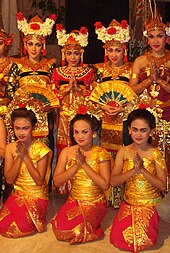
Balinese dancers show for tourists, in Ubud.
Imperial Japan occupied Bali during World War II. Bali Island was not originally a target in their Netherlands East Indies Campaign, but as the airfields on Borneo were inoperative due to heavy rains the Imperial Japanese Army decided to occupy Bali, which did not suffer from comparable weather. The island had no regular Royal Netherlands East Indies Army (KNIL) troops. There was only a Native Auxiliary Corps Prajoda (Korps Prajoda) consisting of about 600 native soldiers and several Dutch KNIL officers under command of KNIL Lieutenant Colonel W.P. Roodenburg. On 19 February 1942 the Japanese forces landed near the town of Senoer. The island was quickly captured.
During the Japanese occupation a Balinese military officer, Gusti Ngurah Rai, formed a Balinese 'freedom army'. The lack of institutional changes from the time of Dutch rule however, and the harshness of war requisitions made Japanese rule little better than the Dutch one. Following Japan's Pacific surrender in August 1945, the Dutch promptly returned to Indonesia, including Bali, immediately to reinstate their pre-war colonial administration. This was resisted by the Balinese rebels now using Japanese weapons. On 20 November 1946, the Battle of Marga was fought in Tabanan in central Bali. Colonel I Gusti Ngurah Rai, by then 29 years old, finally rallied his forces in east Bali at Marga Rana, where they made a suicide attack on the heavily armed Dutch. The Balinese battalion was entirely wiped out, breaking the last thread of Balinese military resistance. In 1946 the Dutch constituted Bali as one of the 13 administrative districts of the newly proclaimed State of East Indonesia, a rival state to the Republic of Indonesia which was proclaimed and headed by Sukarno and Hatta. Bali was included in the "Republic of the United States of Indonesia" when the Netherlands recognised Indonesian independence on 29 December 1949.
The 1963 eruption of Mount Agung killed thousands, created economic havoc and forced many displaced Balinese to be transmigrated to other parts of Indonesia. Mirroring the widening of social divisions across Indonesia in the 1950s and early 1960s, Bali saw conflict between supporters of the traditional caste system, and those rejecting these traditional values. Politically, this was represented by opposing supporters of the Indonesian Communist Party (PKI) and the Indonesian Nationalist Party (PNI), with tensions and ill-feeling further increased by the PKI's land reform programs. An attempted coup in Jakarta was put down by forces led by General Suharto. The army became the dominant power as it instigated a violent anti-communist purge, in which the army blamed the PKI for the coup. Most estimates suggest that at least 500,000 people were killed across Indonesia, with an estimated 80,000 killed in Bali, equivalent to 5% of the island's population. With no Islamic forces involved as in Java and Sumatra, upper-caste PNI landlords led the extermination of PKI members.
As a result of the 1965/66 upheavals, Suharto was able to manoeuvre Sukarno out of the presidency, and his "New Order" government reestablished relations with western countries. The pre-War Bali as "paradise" was revived in a modern form, and the resulting large growth in tourism has led to a dramatic increase in Balinese standards of living and significant foreign exchange earned for the country.A bombing in 2002 by militant Islamists in the tourist area of Kuta killed 202 people, mostly foreigners. This attack, and another in 2005, severely affected tourism, bringing much economic hardship to the island, although tourist numbers have now returned to levels before the bombings.
GEOGRAPHY 
The island of Bali lies 3.2 km (2 mi) east of Java, and is approximately 8 degrees south of the equator. Bali and Java are separated by the Bali Strait. East to west, the island is approximately 153 km (95 mi) wide and spans approximately 112 km (69 mi) north to south; its land area is 5,632 km².
Bali's central mountains include several peaks over 3,000 metres in elevation. The highest is Mount Agung (3,031 m), known as the "mother mountain" which is an active volcano. Mountains range from centre to the eastern side, with Mount Agung the easternmost peak. Bali's volcanic nature has contributed to its exceptional fertility and its tall mountain ranges provide the high rainfall that supports the highly productive agriculture sector. South of the mountains is a broad, steadily descending area where most of Bali's large rice crop is grown. The northern side of the mountains slopes more steeply to the sea and is the main coffee producing area of the island, along with rice, vegetables and cattle. The longest river, Ayung River, flows approximately 75 km.
The island is surrounded by coral reefs. Beaches in the south tend to have white sand while those in the north and west have black sand. Bali has no major waterways, although the Ho River is navigable by small sampan boats. Black sand beaches between Pasut and Klatingdukuh are being developed for tourism, but apart from the seaside temple of Tanah Lot, they are not yet used for significant tourism.
Subak irrigation system
The largest city is the provincial capital, Denpasar, near the southern coast. Its population is around 491,500 (2002). Bali's second-largest city is the old colonial capital, Singaraja, which is located on the north coast and is home to around 100,000 people. Other important cities include the beach resort, Kuta, which is practically part of Denpasar's urban area, and Ubud, situated at the north of Denpasar, is the island's cultural centre.
Three small islands lie to the immediate south east and all are administratively part of the Klungkung regency of Bali: Nusa Penida, Nusa Lembongan and Nusa Ceningan. These islands are separated from Bali by the Badung Strait.
To the east, the Lombok Strait separates Bali from Lombok and marks the biogeographical division between the fauna of the Indomalayan ecozone and the distinctly different fauna of Australasia. The transition is known as the Wallace Line, named after Alfred Russel Wallace, who first proposed a transition zone between these two major biomes. When sea levels dropped during the Pleistocene ice age, Bali was connected to Java and Sumatra and to the mainland of Asia and shared the Asian fauna, but the deep water of the Lombok Strait continued to keep Lombok and the Lesser Sunda archipelago isolated.

ECOLOGY

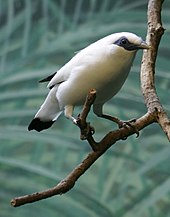
Bali lies just to the west of the Wallace Line, and thus has a fauna which is Asian in character, with very little Australasian influence, and has more in common with Java than with Lombok. An exception is the Yellow-crested Cockatoo, a member of a primarily Australasian family. There are around 280 species of birds, including the critically endangered Bali Starling, which is endemic. Others Include Barn Swallow, Black-naped Oriole, Black Racket-tailed Treepie, Crested Serpent-eagle, Crested Treeswift, Dollarbird, Java Sparrow, Lesser Adjutant, Long-tailed Shrike, Milky Stork, Pacific Swallow, Red-rumped Swallow, Sacred Kingfisher, Sea Eagle, Woodswallow, Savanna Nightjar, Stork-billed Kingfisher, Yellow-vented Bulbul, White Heron, Great Egret.

Jalak Bali Bird

Until the early 20th century, Bali was home to several large mammals: the wild Banteng, leopard and the endemic Bali Tiger. The Banteng still occurs in its domestic form, while leopards are found only in neighboring Java, and the Bali Tiger is extinct. The last definite record of a Tiger on Bali dates from 1937, when one was shot, though the subspecies may have survived until the 1940s or 1950s. The relatively small size of the island, conflict with humans, poaching and habitat reduction drove the Tiger to extinction. This was the smallest and rarest of all Tiger subspecies and was never caught on film or displayed in zoos, while few skins or bones remain in museums around the world. Today, the largest mammals are the Javan Rusa deer and the Wild Boar. A second, smaller species of deer, the Indian Muntjac, also occurs. Saltwater crocodiles were once present on the island, but became locally extinct sometime during the last century.


Monkey Forest, Ubud
Squirrels are quite commonly encountered, less often is the Asian Palm Civet, which is also kept in coffee farms to produce Kopi Luwak. Bats are well represented, perhaps the most famous place to encounter them remaining the Goa Lawah (Temple of the Bats) where they are worshipped by the locals and also constitute a tourist attraction. They also occur in other cave temples, for instance at Gangga Beach. Two species of monkey occur. The Crab-eating Macaque, known locally as “kera”, is quite common around human settlements and temples, where it becomes accustomed to being fed by humans, particularly in any of the three “monkey forest” temples, such as the popular one in the Ubud area. They are also quite often kept as pets by locals. The second monkey, endemic to Java and some surrounding islands, such as Bali which is far rarer and more elusive is the Javan Langur, locally known as "lutung". They occur in few places apart from the Bali Barat National Park. They are born an orange colour, though by their first year they would have already changed to a more blackish colouration. In Java however, there is more of a tendency for this species to retain its juvenile orange colour into adulthood, and so you can see a mixture of black and orange monkeys together as a family. Other rarer mammals include the Leopard Cat, Sunda Pangolin and Black Giant Squirrel.
Snakes include the King Cobra and Reticulated Python. The Water Monitor can grow to at least 1.5 m (4.9 ft) in length and 50 kg (110 lb) and can move quickly.
The rich coral reefs around the coast, particularly around popular diving spots such as Tulamben, Amed, Menjangan or neighboring Nusa Penida, host a wide range of marine life, for instance Hawksbill Turtle, Giant Sunfish, Giant Manta Ray, Giant Moray Eel, Bumphead Parrotfish, Hammerhead Shark, Reef Shark, barracuda, and sea snakes. Dolphins are commonly encountered on the north coast near Singaraja and Lovina.
A team of scientists conducted a survey from 29 April 2011 to 11 May 2011 at 33 sea sites around Bali. They discovered 952 species of reef fish of which 8 were new discoveries at Pemuteran, Gilimanuk, Nusa Dua, Tulamben and Candidasa, and 393 coral species, including two new ones at Padangbai and between Padangbai and Amed. The average coverage level of healthy coral was 36 percent (better than in Raja Ampat and Halmahera by 29 percent or in Fakfak and Kaimana by 25 percent) with the highest coverage found in Gili Selang and Gili Mimpang in Candidasa, Karangasem regency.
Many plants have been introduced by humans within the last centuries, particularly since the 20th century, making it sometimes hard to distinguish what plants are really native. Among the larger trees the most common are: Banyan trees, Jackfruit, coconuts, bamboo species, acacia trees and also endless rows of coconuts and banana species. Numerous flowers can be seen: hibiscus, frangipani, bougainvillea, poinsettia, oleander, jasmine, water lily, lotus, roses, begonias, orchids and hydrangeas exist. On higher grounds that receive more moisture, for instance around Kintamani, certain species of fern trees, mushrooms and even pine trees thrive well. Rice comes in many varieties. Other plants with agricultural value include: salak, mangosteen, corn, Kintamani orange, coffee and water spinach.

The overview of the history of Bali. For the next Post I will discuss culture and tradition in Bali.